Iodine commonly forms I- I+ I5+ I7+ in introductory ionic compounds.
Iodine is the iodide ion I- in salts — including the KI added to iodized table salt that prevents goiter — and climbs to +5 in iodate (IO3-) and +7 in periodate with oxygen. Your thyroid hormones are built around iodine at -1-like covalent state.
Element
Iodine
Symbol
I
Atomic number
53
Common ionic charge
-1, +1, +5, +7
Common ions
I-, I+, I5+, I7+
Visual reference
Iodine element image and atomic model
Images are used as visual references; charge rules still depend on the compound.
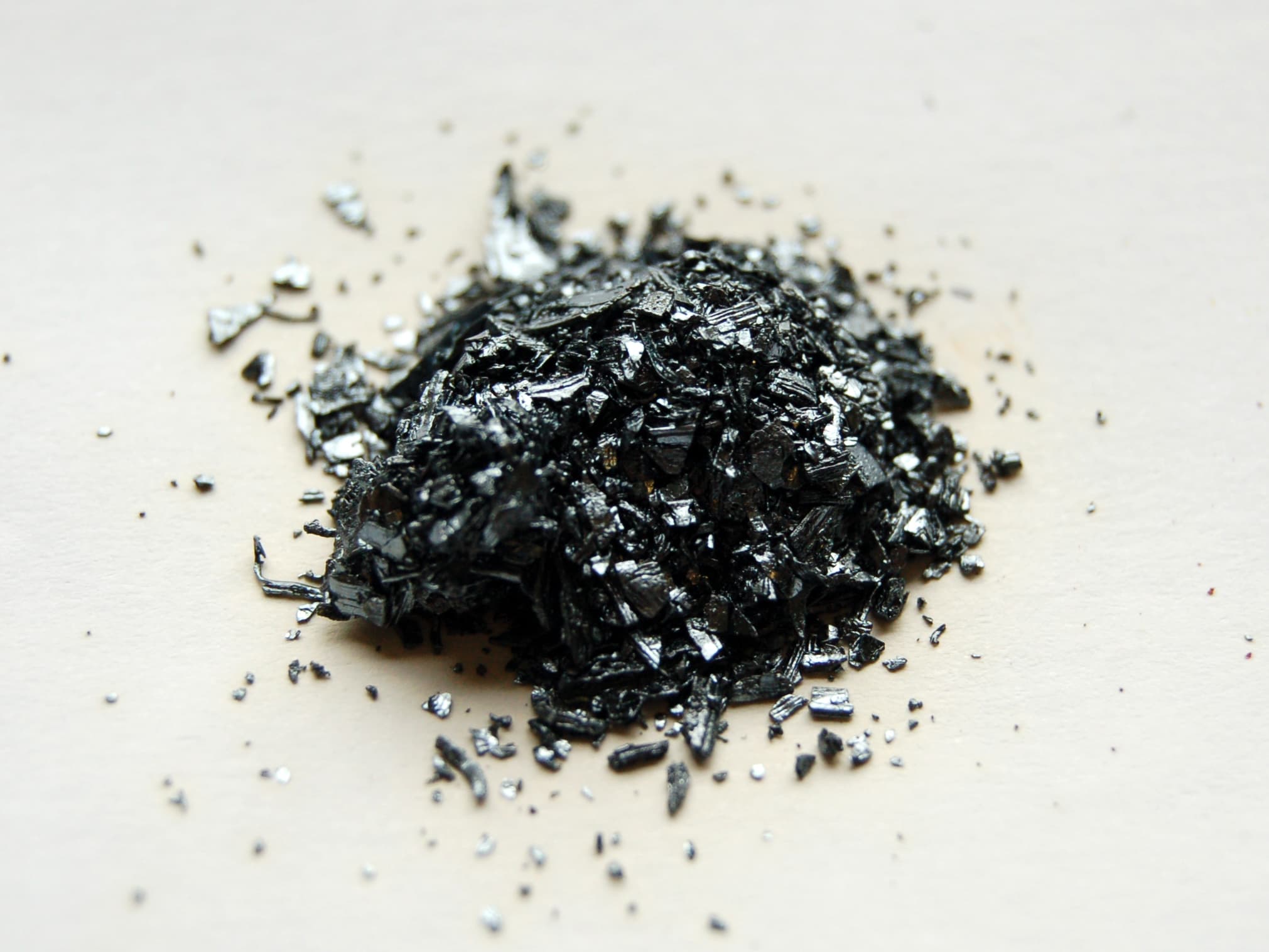
Iodine sample imageBenjah-bmm27, Public domain, via Wikimedia CommonsOriginal image sourceIodine Bohr modelAtomic model image from the open Periodic-Table-JSON dataset. It is a simplified electron-shell reference, not a scale drawing.Original Bohr model source
Why Iodine pulls one electron in
Iodine is [Kr]4d10 5s2 5p5, one electron short of xenon — the halogen -1 story. As the least electronegative common halogen (2.66), it surrenders electrons to oxygen more gracefully than chlorine does, making its positive oxyanion states comparatively stable and easy to form.
The Iodine mix-up to watch for
Calling tincture of iodine 'iodide.' The antiseptic's active species is elemental I2 (charge 0) dissolved with KI; the killing power belongs to the neutral molecule. Iodide (I-) is the nutrient form — same element, opposite roles.
Worked example: I in a formula problem
Some countries iodize salt with potassium iodate instead of iodide. Compare the charges.
KI carries iodine at -1; KIO3 carries it at +5 (three O at -6, K at +1, so I = +5). Iodate resists oxidation in humid climates better, and the body reduces it to iodide after ingestion.
I- and I+ and I5+ and I7+ in real compounds
NaI
sodium iodine compound
Sodium ions can balance I- in simple ionic examples.
CaI2
calcium iodine compound
Calcium ions can balance common negative Iodine ions.
Questions students ask about iodine
Why do nuclear emergency kits contain potassium iodide?
Flooding the thyroid with stable I- blocks uptake of radioactive iodine-131. It exploits the gland's indiscriminate appetite for the iodide ion, whatever its nucleus.
What is the iodine clock reaction's charge story?
Iodate (+5) and bisulfite race through redox steps that hold iodine at -1 until the moment reducing agent runs out — then I2 (charge 0) forms and the starch indicator snaps blue-black. A charge relay with a dramatic finish.
Why does iodine sublime purple while other halogens are gases?
Bigger electron clouds mean stronger London forces, holding I2 solid at room temperature. The violet vapor is neutral I2 molecules — the same molecules, gaseous, that stain starch and fingerprints.