Write the formula for ruthenium(III) chloride, the common starting salt.
Ru3+ with three Cl-: RuCl3. Nearly all ruthenium lab chemistry — catalysts, dyes, electrode preparations — begins from this dark-brown solid.
Ruthenium commonly forms Ru3+ Ru4+ in introductory ionic compounds.
| Element | Ruthenium |
|---|---|
| Symbol | Ru |
| Atomic number | 44 |
| Common ionic charge | +3, +4 |
| Common ions | Ru3+, Ru4+ |
Images are used as visual references; charge rules still depend on the compound.
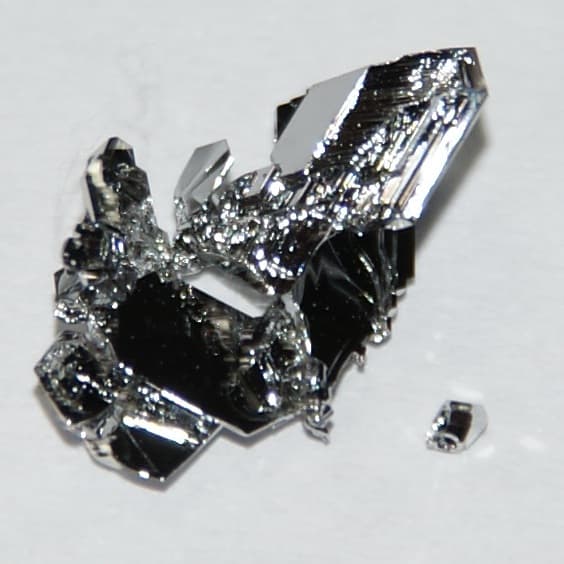
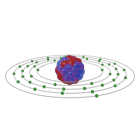
Ruthenium is [Kr]4d7 5s1. Its many d electrons and middling electronegativity open an unusually broad ladder of oxidation states (-2 to +8, the widest span known alongside osmium). For everyday purposes, though, the +3/+4 pair covers its chemistry.
This is a classroom reference range, not an exhaustive list of all oxidation states.
Treating RuO4 like the familiar dioxide. Ruthenium tetroxide (+8) is volatile, toxic, and aggressive — used in trace-lab work to stain fingerprints and cross-section polymers. The +4 dioxide is a tame electrode material. Twenty-six electrons of difference in formula, worlds apart in behavior.
Ru3+ with three Cl-: RuCl3. Nearly all ruthenium lab chemistry — catalysts, dyes, electrode preparations — begins from this dark-brown solid.
Ruthenium chloride
Ru3+ balances chloride ions.
Ruthenium oxide
Ruthenium can form oxides where total positive and negative charge balances.
RuO2 (+4) coats the titanium anodes that make chlorine industrially — the 'dimensionally stable anode' that quietly replaced graphite worldwide. Hard drives also layer neutral ruthenium atoms nanometers thick.
Dye-sensitized ('Grätzel') cells used Ru2+ complexes whose excited electrons inject into titanium dioxide. The ruthenium cycles 2+/3+ every time a photon lands — charge change as the engine of the device.
It is one of the six platinum-group metals — dense, rare, catalytic. Like platinum it often works at charge 0 as a metal catalyst, with its ionic states (+3/+4) reserved for solution chemistry.
Combine positive and negative ions so the total charge is zero — or let the ionic compound calculator do the crossing for you. The full chart lives on the periodic table with charges.
Charges and element facts on this page are checked against the primary references below. Found an error? Email hello@periodictablewithcharges.com — corrections ship in the next content update. See how this site is edited.