Plutonium commonly forms Pu3+ Pu4+ Pu5+ Pu6+ in introductory ionic compounds.
Plutonium is the periodic table's redox showoff: +3, +4, +5, and +6 are all accessible (with +4 most important — PuO2 is the standard solid form), and under the right acid conditions FOUR different plutonium charges can sit in the same solution simultaneously.
Element
Plutonium
Symbol
Pu
Atomic number
94
Common ionic charge
+3, +4, +5, +6
Common ions
Pu3+, Pu4+, Pu5+, Pu6+
Visual reference
Plutonium element image and atomic model
Images are used as visual references; charge rules still depend on the compound.
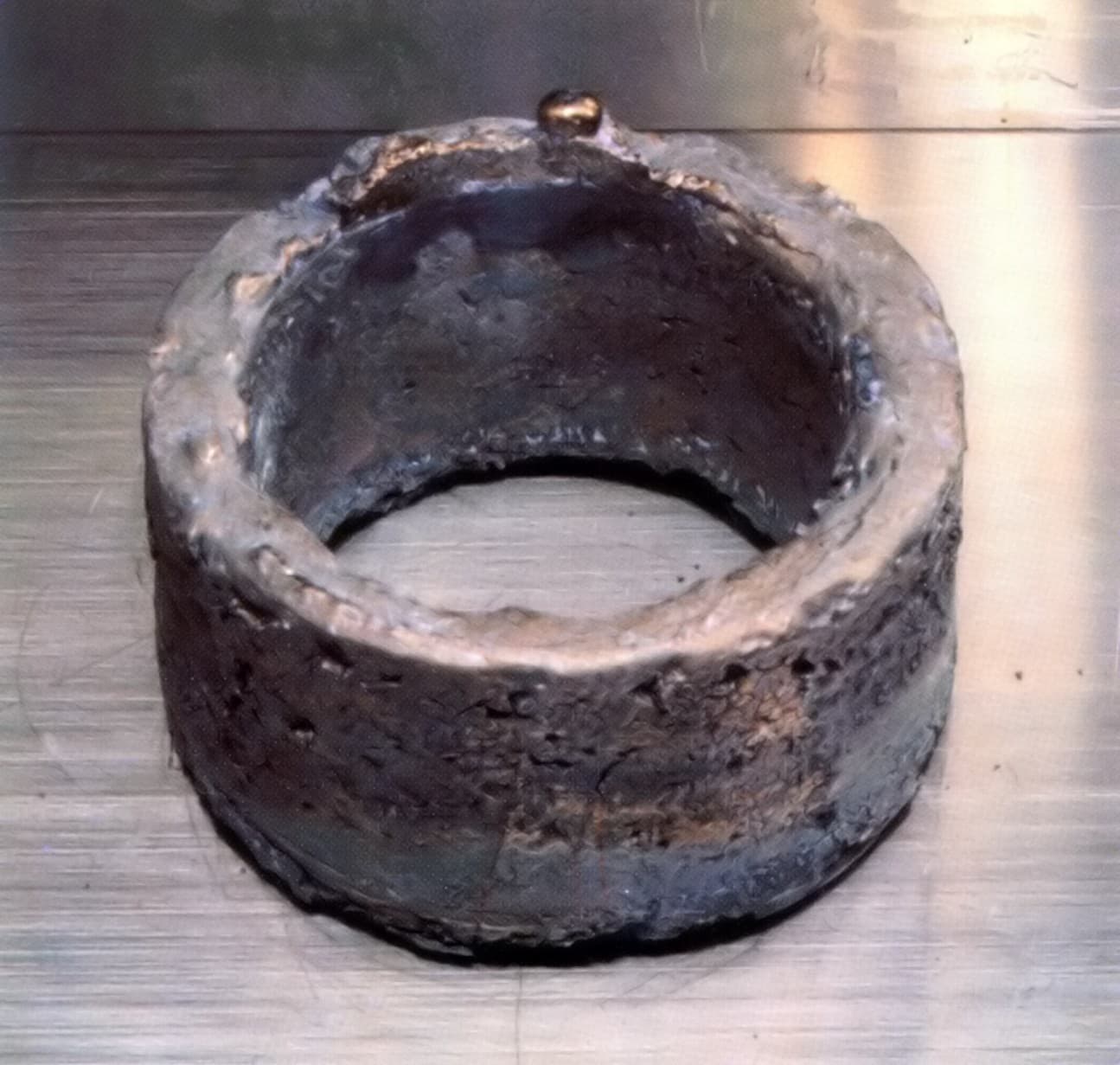
Plutonium sample imageLos Alamos National Laboratory, Attribution, via Wikimedia CommonsOriginal image sourcePlutonium Bohr modelAtomic model image from the open Periodic-Table-JSON dataset. It is a simplified electron-shell reference, not a scale drawing.Original Bohr model source
The electron story behind Plutonium's charge
Plutonium is [Rn]5f6 7s2, at the exact point where 5f electrons hover between joining bonds and hiding — so neighboring oxidation states differ by whisker-thin energies. The famous consequence: Pu4+ can disproportionate into +3, +5, and +6 partners, an equilibrium no other element stages so completely.
This is a classroom reference range, not an exhaustive list of all oxidation states.
The assumption that trips people up on Plutonium
Assuming one 'plutonium chemistry' exists. Process chemists must pin plutonium to a chosen state (usually +4 for PUREX extraction) with redox reagents, or it wanders between states mid-procedure. Its charge indecision — plus six crystal forms of the metal — makes it many chemists' vote for the most complicated element.
Worked example: Pu in a formula problem
Find plutonium's oxidation state in PuO2, the form in MOX fuel and space batteries.
Two O at -2 give Pu = +4 — the anchor state. Pu-238's version of this same oxide, glowing softly from decay heat, has powered every Mars rover and both Voyagers beyond the heliopause.
Pu3+ and Pu4+ and Pu5+ and Pu6+ in real compounds
PuCl3
Plutonium chloride
Pu3+ balances chloride ions.
Pu2O3
Plutonium oxide
Plutonium can form oxides where total positive and negative charge balances.
Questions students ask about plutonium
What colors do plutonium's charges show?
Pu3+ blue-violet, Pu4+ tan-brown, PuO2+ pink-ish, PuO2 2+ yellow-orange — licensed-lab lore holds that a mistreated solution can drift through several in an afternoon, chemistry's moodiest element.
Why does +4 dominate plutonium handling?
Pu4+ forms the extraction complexes PUREX runs on and the refractory dioxide for storage — it is the state easiest to hold still. Reprocessing flowsheets are, at heart, plans for policing plutonium's charge.
Is plutonium's hazard chemical like lead or nuclear like radium?
Overwhelmingly nuclear: inhaled Pu4+ particles lodge and irradiate tissue with alphas. Its chemical toxicity is real but secondary — with plutonium, the nucleus writes the safety manual.