Write the formula for rhodium(III) oxide.
Rh3+ and O2- cross to Rh2O3 — the same pattern as aluminum and iron(III) oxides. It forms as a protective gray film if rhodium is heated in air.
Rhodium commonly forms Rh3+ in introductory ionic compounds.
| Element | Rhodium |
|---|---|
| Symbol | Rh |
| Atomic number | 45 |
| Common ionic charge | +3 |
| Common ions | Rh3+ |
Images are used as visual references; charge rules still depend on the compound.
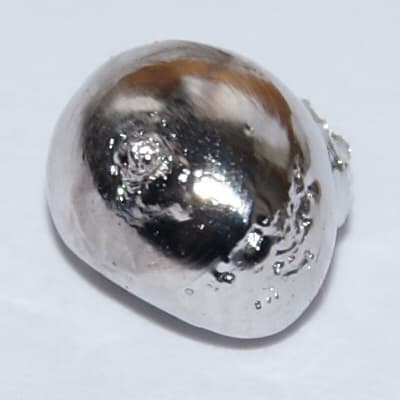
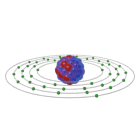
Rhodium is [Kr]4d8 5s1. The +3 state (d6) is exceptionally comfortable — low-spin d6 complexes are the poster children of stability in coordination chemistry — so rhodium rarely strays from it in simple compounds. The +1 state matters in industrial catalysis cycles.
This is a classroom reference range, not an exhaustive list of all oxidation states.
Assuming the most expensive metal must have exotic charge behavior. Rhodium's record prices (it has traded above gold many times over) come from scarcity and catalytic demand, not chemistry: its charge rules are among the most predictable in the d-block.
Rh3+ and O2- cross to Rh2O3 — the same pattern as aluminum and iron(III) oxides. It forms as a protective gray film if rhodium is heated in air.
Rhodium chloride
Rh3+ balances chloride ions.
Rhodium oxide
Rhodium can form oxides where total positive and negative charge balances.
Zero — jewelers electroplate a micron of neutral rhodium metal for its brilliant, tarnish-proof white. During the plating itself, Rh3+ ions in the bath gain three electrons each to become that metal film.
Neutral rhodium surfaces are uniquely good at tearing apart NO molecules, letting nitrogen pair off harmlessly as N2. Platinum and palladium handle the CO and hydrocarbons; NOx is rhodium's job.
Industrial homogeneous catalysis: Wilkinson's catalyst and the Monsanto acetic-acid process both cycle rhodium between +1 and +3. Each round trip through those charges stitches molecules together at ton scale.
Combine positive and negative ions so the total charge is zero — or let the ionic compound calculator do the crossing for you. The full chart lives on the periodic table with charges.
Charges and element facts on this page are checked against the primary references below. Found an error? Email hello@periodictablewithcharges.com — corrections ship in the next content update. See how this site is edited.