Europium commonly forms Eu2+ Eu3+ in introductory ionic compounds.
Europium works both of its charges for a living: Eu3+ phosphors glow red, Eu2+ phosphors glow blue — together they lit every CRT television and still light white LEDs and the anti-counterfeit fibers in euro banknotes.
Element
Europium
Symbol
Eu
Atomic number
63
Common ionic charge
+2, +3
Common ions
Eu2+, Eu3+
Visual reference
Europium element image and atomic model
Images are used as visual references; charge rules still depend on the compound.
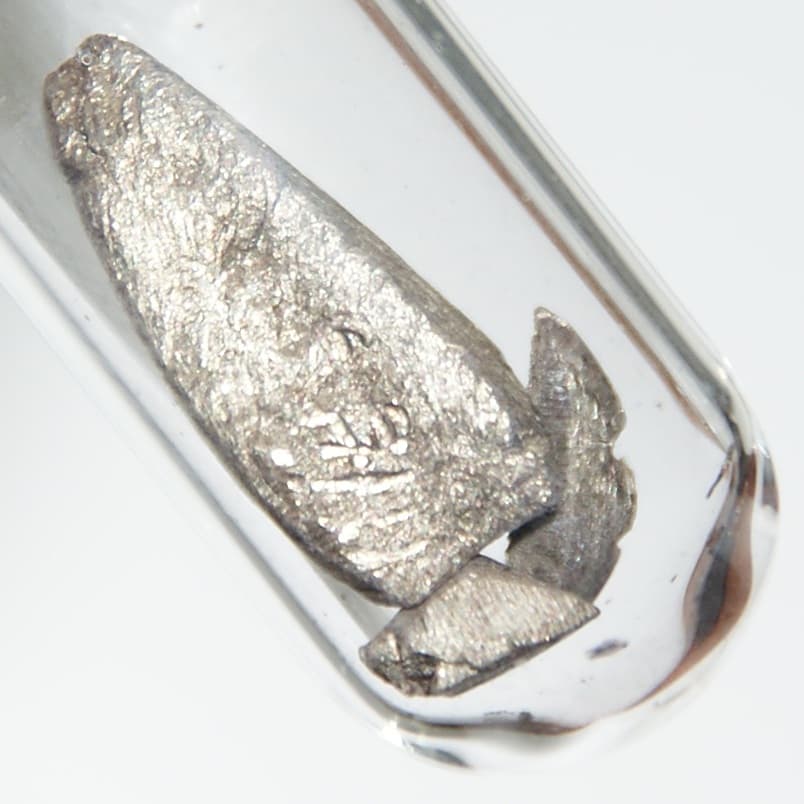
Europium sample imageJurii, CC BY 3.0 <https://creativecommons.org/licenses/by/3.0>, via Wikimedia Commons, source: https://images-of-elements.com/europium.phpOriginal image sourceEuropium Bohr modelAtomic model image from the open Periodic-Table-JSON dataset. It is a simplified electron-shell reference, not a scale drawing.Original Bohr model source
The electron story behind Europium's charge
Europium is [Xe]4f7 6s2. Losing two electrons keeps the perfectly half-filled f7 shell, making Eu2+ the most stable divalent lanthanide by far; losing three gives conventional Eu3+ (f6). The two states sit close enough that phosphor chemists simply pick the host crystal that stabilizes the color they want.
This is a classroom reference range, not an exhaustive list of all oxidation states.
The assumption that trips people up on Europium
Assuming the lanthanide +3 rule has no real exceptions. Europium is the strongest one: Eu2+ is stable enough to survive in minerals, and geologists read 'europium anomalies' in rocks — Eu2+ substituting for Ca2+ in feldspar — as a fingerprint of how magmas evolved.
Worked example: Eu in a formula problem
Write the formula for europium(II) sulfate and explain why it resembles barium sulfate.
Eu2+ with SO4 2- gives EuSO4 — and like BaSO4 it is water-insoluble, because Eu2+ (117 pm) is nearly a twin of Ba2+ in size and charge. Charge and radius, not element identity, drive solubility patterns.
Eu2+ and Eu3+ in real compounds
EuCl2
Europium chloride
Eu2+ balances chloride ions.
EuO
Europium oxide
Europium can form oxides where total positive and negative charge balances.
Questions students ask about europium
How do euro banknotes use europium's charges?
Under UV light, embedded Eu3+ complexes fluoresce red and Eu2+ phosphors add blue-green — a luminescent signature that is easy to verify and hard to counterfeit.
Which europium charge is in white LEDs?
Usually Eu2+, doped into nitride or garnet hosts, converting blue LED light into the warm tones. Shift the host lattice and the same 2+ ion emits anywhere from blue to red.
Why is europium said to be the most reactive lanthanide metal?
The metal's electrons are arranged so it behaves almost like an alkaline-earth: it tarnishes in seconds and reacts with water like calcium — a preview of the 2+ character its ion is famous for.