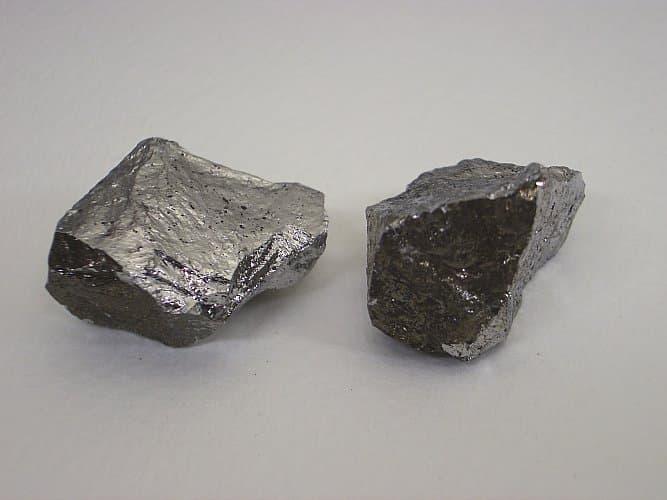
Manganese commonly forms Mn2+ Mn4+ Mn7+ in introductory ionic compounds.
Manganese's most common ionic charge is +2 (pale-pink MnCl2, MnSO4 in fertilizer). You will also meet +4 in MnO2 — the black powder inside alkaline batteries — and +7 in the deep-purple permanganate ion, MnO4-.
Element
Manganese
Symbol
Mn
Atomic number
25
Common ionic charge
+2, +4, +7
Common ions
Mn2+, Mn4+, Mn7+
Visual reference
Manganese element image and atomic model
Images are used as visual references; charge rules still depend on the compound.
Manganese sample imageW. Oelen, CC BY-SA 3.0 <https://creativecommons.org/licenses/by-sa/3.0>, via Wikimedia CommonsOriginal image sourceManganese Bohr modelAtomic model image from the open Periodic-Table-JSON dataset. It is a simplified electron-shell reference, not a scale drawing.Original Bohr model source
Where Manganese's charge options come from
Manganese is [Ar]3d5 4s2. Losing the two 4s electrons leaves the half-filled d5 configuration — a stability sweet spot that makes Mn2+ the default. From there, oxygen can pull manganese stepwise all the way to +7, where all seven valence electrons are engaged.
This is a classroom reference range, not an exhaustive list of all oxidation states.
The trap in Manganese problems
Confusing manganese (Mn) with magnesium (Mg). Beyond the similar names, magnesium is always +2 while manganese merely defaults to +2 — MnO2 and KMnO4 have no magnesium counterparts. Check the symbol before assigning charge.
Worked example: Mn in a formula problem
What is manganese's oxidation state in KMnO4, and why does it matter?
K is +1, four O are -8, so Mn = +7. At its maximum state manganese is a voracious electron acceptor — which is exactly why permanganate is a go-to oxidizer for titrations and water treatment.
Mn2+ and Mn4+ and Mn7+ in real compounds
MnCl2
Manganese chloride
Mn2+ balances chloride ions.
MnO
Manganese oxide
Manganese can form oxides where total positive and negative charge balances.
Questions students ask about manganese
What happens to permanganate's color during a titration?
As Mn7+ gains electrons and drops to nearly colorless Mn2+, the purple vanishes. The endpoint announces itself when one extra drop stays pink — a self-indicating reaction.
What charge does manganese have inside an alkaline battery?
It starts at +4 in MnO2 and steps down toward +3 as the battery discharges, absorbing the electrons your device pushes through the circuit.
Is Mn2+ colorful like other transition metals?
Barely — its solutions are the palest pink. The half-filled d5 arrangement makes the usual light-absorbing electron jumps 'spin-forbidden,' so almost no visible light is absorbed.