Predict the formula of promethium(III) oxide.
Pm3+ with O2- crosses to Pm2O3 — identical in pattern to its neighbors Nd2O3 and Sm2O3.
Promethium commonly forms Pm3+ in introductory ionic compounds.
| Element | Promethium |
|---|---|
| Symbol | Pm |
| Atomic number | 61 |
| Common ionic charge | +3 |
| Common ions | Pm3+ |
Images are used as visual references; charge rules still depend on the compound.

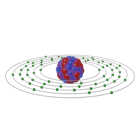
Promethium is [Xe]4f5 6s2, and the usual three-electron departure gives Pm3+ (f4). Nothing about nuclear instability alters that: electron chemistry and nuclear decay are separate ledgers, so promethium slots neatly between neodymium and samarium in every chemical trend.
This is a classroom reference range, not an exhaustive list of all oxidation states.
Assuming an element 'missing from nature' must have strange chemistry. Promethium's rarity is purely nuclear — its most stable isotope lasts under 18 years, so primordial promethium decayed away eons ago. Chemically it is as ordinary a +3 lanthanide as they come.
Pm3+ with O2- crosses to Pm2O3 — identical in pattern to its neighbors Nd2O3 and Sm2O3.
Promethium chloride
Pm3+ balances chloride ions.
Promethium oxide
Promethium can form oxides where total positive and negative charge balances.
Yes — mid-century luminous paint mixed Pm-147 (as a +3 salt) with a phosphor, replacing the more hazardous radium. Its soft beta decay lit the phosphor without radium's penetrating gamma rays.
Nuclear reactors: it is fished out of fission products, as Pm3+, by the same ion-exchange chemistry used to separate all the look-alike lanthanide ions.
Betavoltaic cells let Pm-147's beta electrons strike a semiconductor and generate current — nuclear decay in, electricity out. The promethium sits there as an ordinary +3 compound while its nuclei do the work.
Combine positive and negative ions so the total charge is zero — or let the ionic compound calculator do the crossing for you. The full chart lives on the periodic table with charges.
Charges and element facts on this page are checked against the primary references below. Found an error? Email hello@periodictablewithcharges.com — corrections ship in the next content update. See how this site is edited.