Assign xenon's oxidation state in XeF4.
Fluorine is always -1; four of them give -4, so xenon is +4. Square-planar XeF4 even shows up on VSEPR exams — the noble gas doing geometry homework.
Xenon does not have a common simple ionic charge in introductory chemistry.
| Element | Xenon |
|---|---|
| Symbol | Xe |
| Atomic number | 54 |
| Common ionic charge | none listed |
| Common ions | none listed |
Images are used as visual references; charge rules still depend on the compound.
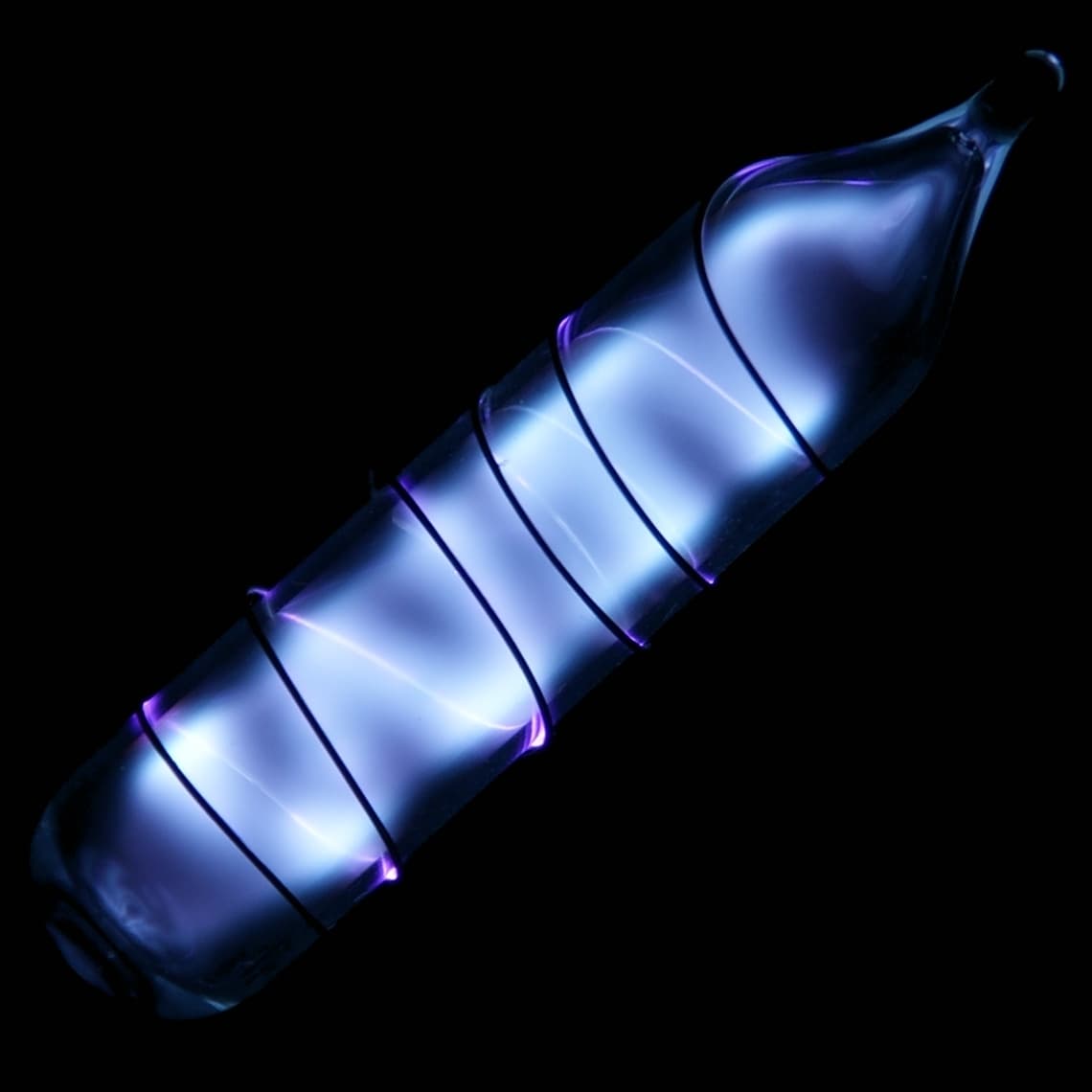
Xenon's [Kr]4d10 5s2 5p6 octet is complete, but its outermost electrons orbit far from the nucleus — ionization energy is down to 1,170 kJ/mol, low enough that fluorine and oxygen can lever electrons into shared bonds. Neil Bartlett's 1962 synthesis of the first xenon compound rewrote the 'inert gas' chapter of every textbook.
No common simple ion is listed; verify advanced oxidation-state chemistry with a primary reference.
Writing 'noble gases never react' on exams. Heavier ones can: xenon has an entire compound family, krypton has KrF2. The accurate statement is that Group 18 elements have no common ions and react only under forcing conditions with the most electronegative partners.
Fluorine is always -1; four of them give -4, so xenon is +4. Square-planar XeF4 even shows up on VSEPR exams — the noble gas doing geometry homework.
Distance. Xenon's valence shell is five shells out and loosely held; helium's two electrons hug the nucleus. Reactivity in Group 18 rises steadily downward — He and Ne none, Ar a whisper, Kr a little, Xe real chemistry.
Headlight arcs ionize xenon transiently to carry current (physics, not compound formation). As an anesthetic, xenon works as the neutral atom — dissolving into nerve membranes at charge 0. Both uses need zero chemistry.
+8, in perxenate ion XeO6 4- and XeO4 — every valence electron engaged. Only a handful of elements (Ru, Os, Xe, Ir in one exotic case) ever reach +8.
Combine positive and negative ions so the total charge is zero — or let the ionic compound calculator do the crossing for you. The full chart lives on the periodic table with charges.
Charges and element facts on this page are checked against the primary references below. Found an error? Email hello@periodictablewithcharges.com — corrections ship in the next content update. See how this site is edited.