Argon does not have a common simple ionic charge in introductory chemistry.
Argon carries no charge and forms no chemical compounds. Its [Ne]3s2 3p6 shell is complete, which is exactly why welders and light-bulb makers pump it in — argon's job is to be present and do absolutely nothing.
Element
Argon
Symbol
Ar
Atomic number
18
Common ionic charge
none listed
Common ions
none listed
Visual reference
Argon element image and atomic model
Images are used as visual references; charge rules still depend on the compound.
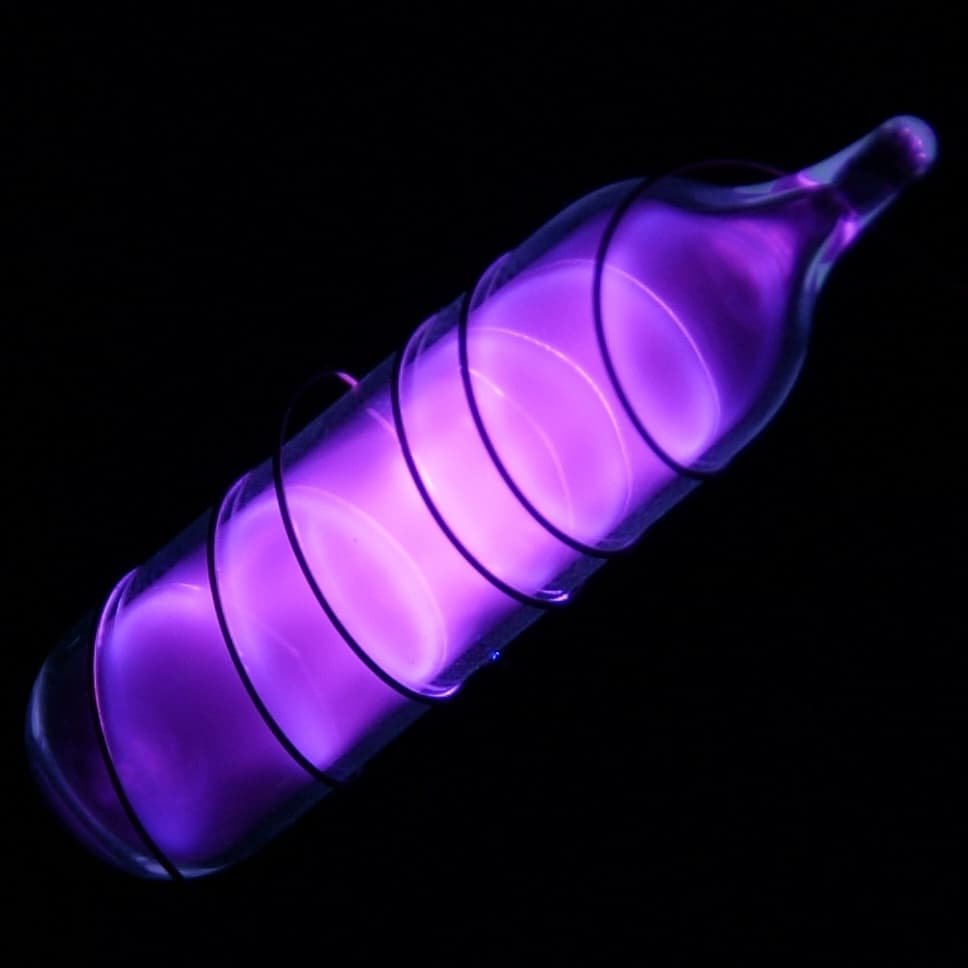
Argon sample imageJurii, CC BY 3.0 <https://creativecommons.org/licenses/by/3.0>, via Wikimedia Commons, source: https://images-of-elements.com/argon.phpOriginal image sourceArgon Bohr modelAtomic model image from the open Periodic-Table-JSON dataset. It is a simplified electron-shell reference, not a scale drawing.Original Bohr model source
Why Argon keeps all its electrons
A filled octet in period 3 leaves argon with no low-energy way to gain, lose, or share electrons. Its first ionization energy (1,521 kJ/mol) towers above its neighbors chlorine and potassium, both of which react eagerly precisely because they are one electron away from argon's arrangement.
No common simple ion is listed; verify advanced oxidation-state chemistry with a primary reference.
What people get wrong about Argon
Assuming 'argon is 1% of air, so it must be doing something.' It isn't — every breath you take carries argon in and out unchanged. Its abundance comes from radioactive potassium-40 decaying to argon-40 in rocks over billions of years.
Worked example: Ar in a formula problem
K+ and Cl- are both said to be 'isoelectronic with argon.' What does that mean?
Both ions hold exactly 18 electrons in argon's configuration. Potassium got there by losing one electron, chloride by gaining one — argon is the stability target on both sides.
Questions students ask about argon
Has any argon compound ever been made?
One: HArF, argon fluorohydride, detected in 2000 at temperatures below -246 °C. It falls apart above that. For chemistry class purposes, argon forms nothing.
Why use argon instead of nitrogen for welding?
Hot metals will even react with N2, forming brittle nitrides. Argon has no such option — no charge states, no compounds — making it the safer blanket for molten metal.
Is the argon in a plasma globe ionized?
Momentarily, yes — electric fields can knock electrons off any atom, making Ar+ that glows lilac. That is physics-grade ionization, gone in microseconds, not chemical bonding.