Find vanadium's oxidation state in the vanadyl ion, VO2+.
Oxygen is -2 and the ion's total is +2, so V - 2 = +2, giving V = +4. Vanadyl (+4) is the blue stage of the famous four-color reduction demo.
Vanadium commonly forms V2+ V3+ V4+ V5+ in introductory ionic compounds.
| Element | Vanadium |
|---|---|
| Symbol | V |
| Atomic number | 23 |
| Common ionic charge | +2, +3, +4, +5 |
| Common ions | V2+, V3+, V4+, V5+ |
Images are used as visual references; charge rules still depend on the compound.
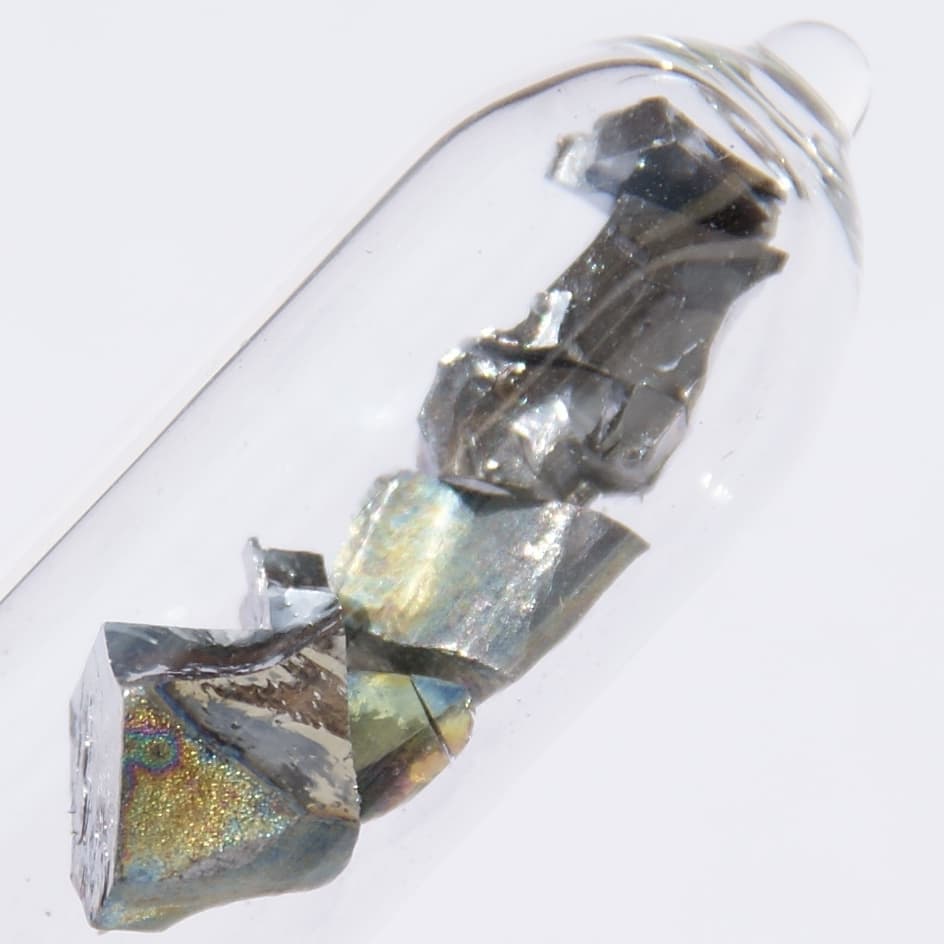
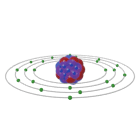
With [Ar]3d3 4s2, vanadium has five removable electrons whose successive ionization costs rise gradually rather than jumping — so each intermediate state is reachable and reasonably stable. That staircase of accessible states is textbook transition-metal behavior.
This is a classroom reference range, not an exhaustive list of all oxidation states.
Assuming the compound's subscript reveals a single 'vanadium charge.' Ask what it is bonded to: in VCl2 vanadium is +2, in V2O5 it is +5. With vanadium you must calculate every time — no default value is safe.
Oxygen is -2 and the ion's total is +2, so V - 2 = +2, giving V = +4. Vanadyl (+4) is the blue stage of the famous four-color reduction demo.
Vanadium chloride
V2+ balances chloride ions.
Vanadium oxide
Vanadium can form oxides where total positive and negative charge balances.
Its four adjacent charge states. Vanadium redox batteries store energy by cycling V2+/V3+ on one side and V4+/V5+ on the other — one element playing all four roles avoids cross-contamination.
In tool steel, vanadium is present as neutral atoms and carbides (formally ~+4). Less than 1% of it makes steel fine-grained and shock-resistant — the original 'vanadium steel' sold Ford's Model T.
Structurally yes: VO4 3- mirrors PO4 3- in shape and charge, with vanadium at +5 standing in for phosphorus. That mimicry is why vanadate can jam phosphate-handling enzymes in biochemistry labs.
Combine positive and negative ions so the total charge is zero — or let the ionic compound calculator do the crossing for you. The full chart lives on the periodic table with charges.
Charges and element facts on this page are checked against the primary references below. Found an error? Email hello@periodictablewithcharges.com — corrections ship in the next content update. See how this site is edited.