Write the formula for praseodymium(III) fluoride, used in some specialty glasses.
Pr3+ with three F-: PrF3 — the same pattern every lanthanide fluoride follows.
Praseodymium commonly forms Pr3+ Pr4+ in introductory ionic compounds.
| Element | Praseodymium |
|---|---|
| Symbol | Pr |
| Atomic number | 59 |
| Common ionic charge | +3, +4 |
| Common ions | Pr3+, Pr4+ |
Images are used as visual references; charge rules still depend on the compound.
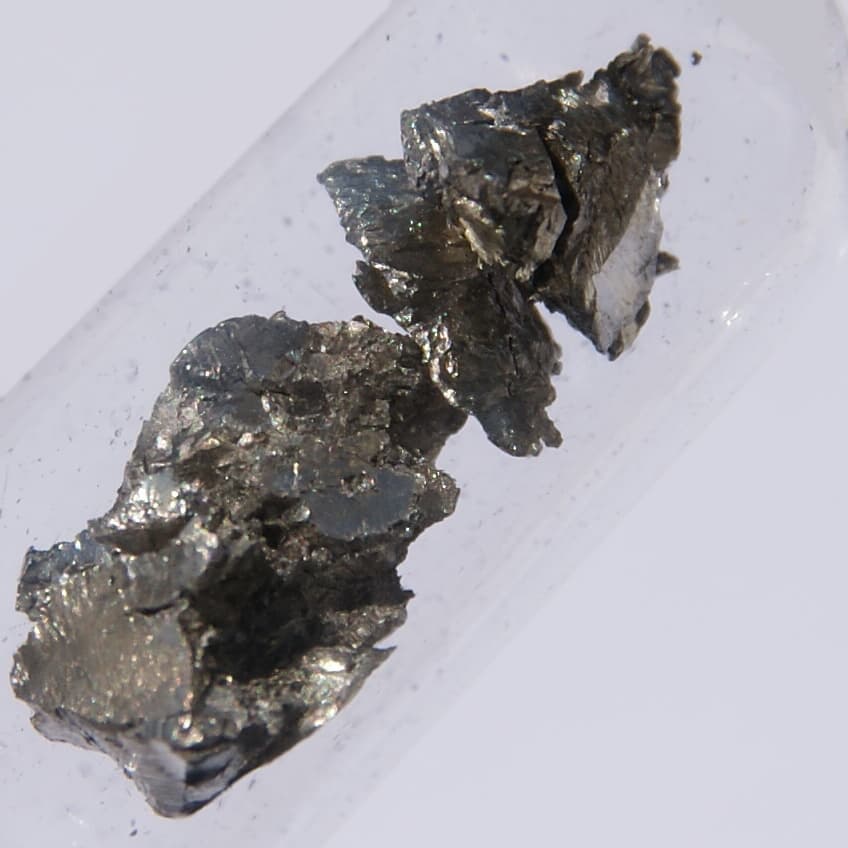
Praseodymium is [Xe]4f3 6s2. The standard lanthanide surrender of three electrons gives Pr3+ (f2). Its f-electron count sits close enough to the empty-shell bonus that mixed oxides can trap some Pr4+, but nothing like cerium's robust +4.
This is a classroom reference range, not an exhaustive list of all oxidation states.
Writing praseodymium's common oxide as PrO2 or Pr2O3 alone. The stable air-formed oxide is actually Pr6O11 — a mixed-valence compound averaging Pr at +3.67, four Pr4+ and two Pr3+ per formula. Lanthanide oxides can be messier than the +3 rule suggests.
Pr3+ with three F-: PrF3 — the same pattern every lanthanide fluoride follows.
Praseodymium chloride
Pr3+ balances chloride ions.
Praseodymium oxide
Praseodymium can form oxides where total positive and negative charge balances.
Welder's didymium glasses: Pr3+ (with neodymium) absorbs the blinding yellow sodium flare from hot glass, letting the artisan watch the work. The 3+ ion's f-f absorptions do the filtering.
It substitutes for neodymium in NdFeB-type magnets (as neutral atoms in the alloy) and improves their corrosion resistance — one 3+ lanthanide standing in for another.
Their f electrons hide beneath outer shells, barely feeling the surroundings — so absorptions are narrow, weak lines rather than transition metals' broad bands. Same 3+ charge, buried orbitals.
Combine positive and negative ions so the total charge is zero — or let the ionic compound calculator do the crossing for you. The full chart lives on the periodic table with charges.
Charges and element facts on this page are checked against the primary references below. Found an error? Email hello@periodictablewithcharges.com — corrections ship in the next content update. See how this site is edited.