Tin commonly forms Sn2+ Sn4+ in introductory ionic compounds.
Tin splits its life between +2 (stannous) and +4 (stannic) almost evenly: SnF2 — 'stannous fluoride' — in toothpaste is +2; SnO2, its natural ore cassiterite, is +4. Names and numerals are not optional with tin — you must be told, or work it out.
Element
Tin
Symbol
Sn
Atomic number
50
Common ionic charge
+2, +4
Common ions
Sn2+, Sn4+
Visual reference
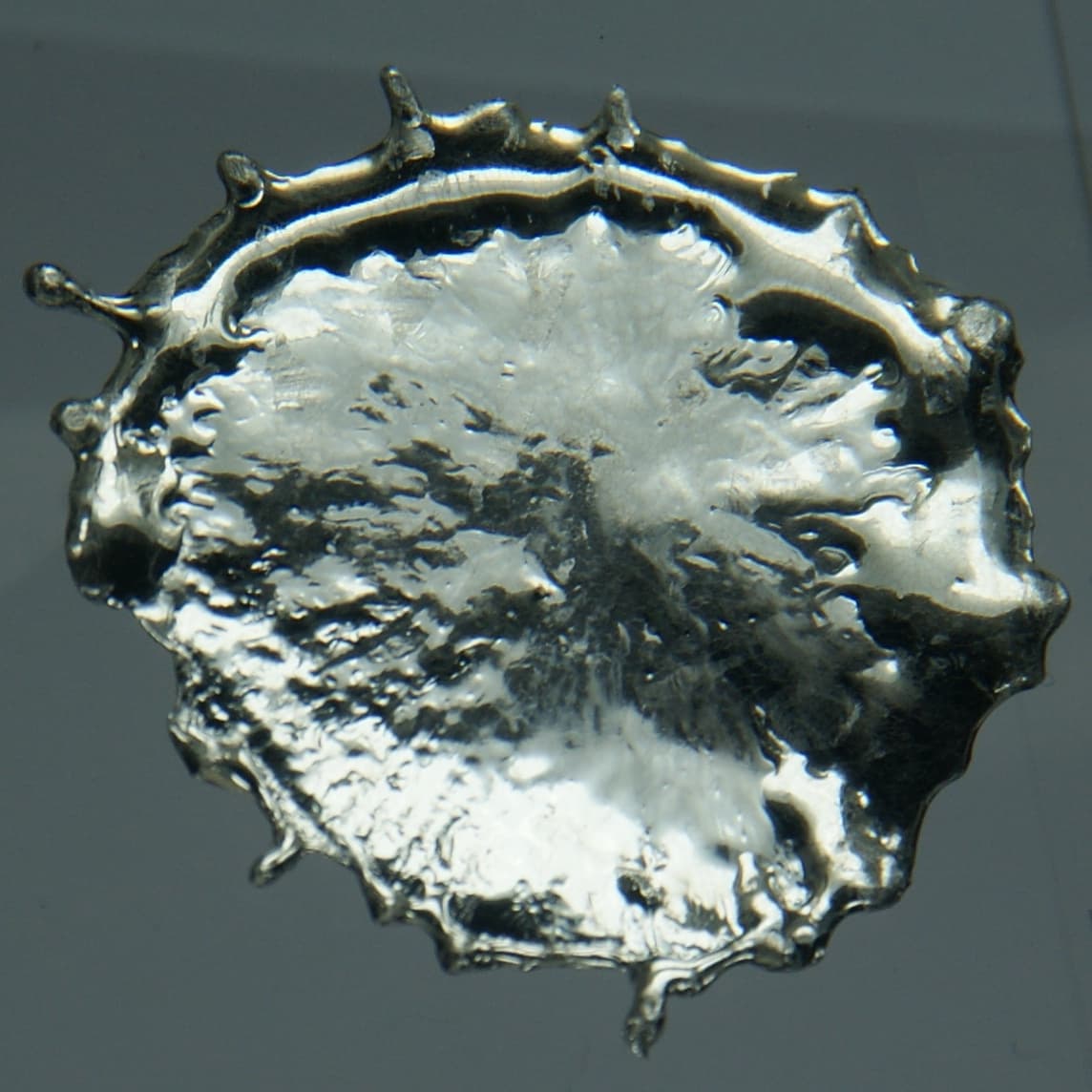
Tin element image and atomic model
Images are used as visual references; charge rules still depend on the compound.
Tin sample imageJurii, CC BY 3.0 <https://creativecommons.org/licenses/by/3.0>, via Wikimedia Commons, source: http://images-of-elements.com/tin.phpOriginal image sourceTin Bohr modelAtomic model image from the open Periodic-Table-JSON dataset. It is a simplified electron-shell reference, not a scale drawing.Original Bohr model source
How Tin's outer electrons decide its charge
Tin is [Kr]4d10 5s2 5p2. Using just the two 5p electrons gives +2; adding the 5s pair gives +4. The inert-pair effect has grown strong enough by period 5 that the 5s pair genuinely hesitates — so neither state dominates, and mild oxidizers shuttle tin between them.
The Tin mistake worth a warning
Assuming 'tin cans' involve tin ions. Cans are steel with a micron of neutral tin metal whose sealed oxide surface resists food acids. Ionic tin appears in the toothpaste tube (Sn2+) and in the ore refinery (Sn4+), not in the pantry.
Worked example: Sn in a formula problem
Name SnCl2 and SnCl4, and note one difference you could observe.
SnCl2 is tin(II) chloride, a white ionic-ish solid used as a reducing agent; SnCl4 is tin(IV) chloride, a fuming covalent liquid. The +4 compound's covalency shows how oxidation state reshapes bonding, not just numbers.
Sn2+ and Sn4+ in real compounds
SnCl2
Tin chloride
Sn2+ balances chloride ions.
SnO
Tin oxide
Tin can form oxides where total positive and negative charge balances.
Questions students ask about tin
Why does toothpaste use stannous (+2) rather than stannic (+4) fluoride?
Sn2+ is itself antimicrobial and helps seal dentin tubules, benefits the inert +4 state cannot deliver. Formulators accept the challenge that Sn2+ slowly oxidizes toward +4 in the tube.
What is 'tin pest' — a charge problem?
No: below 13 °C neutral tin slowly transforms from its metallic form to a brittle powdery allotrope. Organ pipes in cold churches crumbled from it. Same element, same charge 0, different crystal structure.
Which tin state is in window glass manufacturing?
Float glass rides on a bath of molten neutral tin, while the glass's tin-facing side picks up traces of Sn2+. Detecting that faint stannous fluorescence is how factories tell the two glass faces apart.