Thorium commonly forms Th4+ in introductory ionic compounds.
Thorium is +4, full stop — ThO2, ThCl4, Th(NO3)4. Among the early actinides famous for juggling four or five oxidation states, thorium is the disciplined one: its chemistry reads like zirconium's or hafnium's, just radioactive.
Element
Thorium
Symbol
Th
Atomic number
90
Common ionic charge
+4
Common ions
Th4+
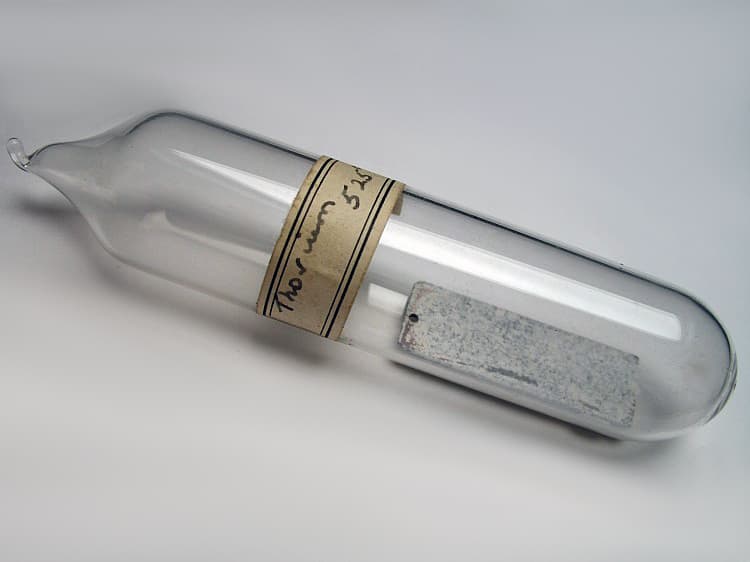
Visual reference
Thorium element image and atomic model
Images are used as visual references; charge rules still depend on the compound.
Thorium sample imageW. Oelen, CC BY-SA 3.0 <https://creativecommons.org/licenses/by-sa/3.0>, via Wikimedia CommonsOriginal image sourceThorium Bohr modelAtomic model image from the open Periodic-Table-JSON dataset. It is a simplified electron-shell reference, not a scale drawing.Original Bohr model source
The electron story behind Thorium's charge
Thorium is [Rn]6d2 7s2. All four outer electrons leave for the radon core, and the resulting Th4+ — big, highly charged, with no f electrons — behaves like a super-sized Zr4+. Its oxide ThO2 has the highest melting point of any binary oxide (3,390 °C).
This is a classroom reference range, not an exhaustive list of all oxidation states.
The assumption that trips people up on Thorium
Assuming everything radioactive is fiercely so. Th-232's half-life is 14 billion years — older than the universe is not required reading for an element to seem 'stable' on human timescales. Handling concerns center on ingestion and decay daughters, not the gentle parent.
Worked example: Th in a formula problem
Write the formula for thorium(IV) oxide and one place it made history.
Th4+ with O2- crosses to ThO2 — the gas-mantle compound that lit streets and campsites for a century: heated ThO2 (with a cerium pinch) glows brilliant white, no electricity required.
Th4+ in real compounds
ThCl4
Thorium chloride
Th4+ balances chloride ions.
Th2O3
Thorium oxide
Thorium can form oxides where total positive and negative charge balances.
Questions students ask about thorium
What is the thorium reactor idea, charge-wise?
Th-232 absorbs a neutron and beta-decays into fissile U-233. In molten-salt designs the thorium circulates as ThF4 (Th4+ in fluoride melt) — the +4 chemistry is the fuel plumbing; the nucleus is the payload.
Why do old camera lenses tick a Geiger counter?
Mid-century 'thoriated' glass used ThO2 for its high refractive index — sharp optics with a whisper of radioactivity that collectors still measure today. The Th4+ sits inert in the glass network.
Is thorium really more abundant than tin?
Crustal thorium (~10 ppm) rivals lead and beats tin — 'rare' it is not. Its energy content in theory exceeds all uranium and fossil reserves combined; engineering, not chemistry, is the barrier.