Cerium commonly forms Ce3+ Ce4+ in introductory ionic compounds.
Cerium is the lanthanide with a genuine second charge: the standard Ce3+, plus a stable Ce4+ — as in CeO2, the pale-yellow polishing powder and catalytic-converter oxygen buffer. That 3+/4+ toggle is cerium's entire industrial personality.
Element
Cerium
Symbol
Ce
Atomic number
58
Common ionic charge
+3, +4
Common ions
Ce3+, Ce4+
Visual reference
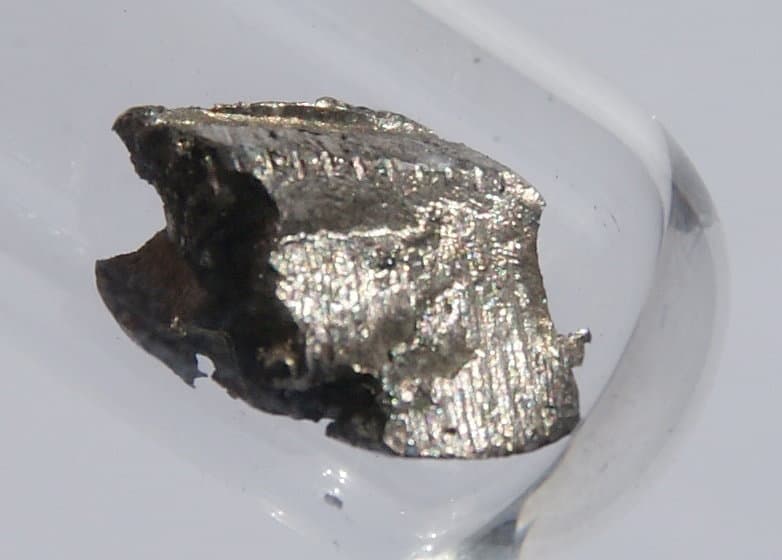
Cerium element image and atomic model
Images are used as visual references; charge rules still depend on the compound.
Cerium sample imageJurii, CC BY 1.0 <https://creativecommons.org/licenses/by/1.0>, via Wikimedia Commons, source: https://images-of-elements.com/cerium.phpOriginal image sourceCerium Bohr modelAtomic model image from the open Periodic-Table-JSON dataset. It is a simplified electron-shell reference, not a scale drawing.Original Bohr model source
The electron story behind Cerium's charge
Cerium is [Xe]4f1 5d1 6s2. Losing three electrons gives typical lanthanide Ce3+, but losing one more empties the f shell entirely (f0) — a stability bonus that makes Ce4+ uniquely accessible among the lanthanides. Praseodymium and terbium manage +4 only in special solids; cerium does it in aqueous solution.
This is a classroom reference range, not an exhaustive list of all oxidation states.
The assumption that trips people up on Cerium
Applying 'lanthanides are always +3' to cerium redox problems. Ceric ammonium nitrate — a standard strong oxidizer on lab shelves — works precisely because Ce4+ hungrily grabs an electron to become Ce3+. The exception is the reagent.
Worked example: Ce in a formula problem
Find cerium's charge in CeO2 and explain its job in catalytic converters.
Two O at -2 make cerium +4. In exhaust, CeO2 releases oxygen (cerium dropping toward +3) when the mix runs rich and re-oxidizes when lean — a solid-state oxygen bank cycling between the two charges thousands of times a minute.
Ce3+ and Ce4+ in real compounds
CeCl3
Cerium chloride
Ce3+ balances chloride ions.
Ce2O3
Cerium oxide
Cerium can form oxides where total positive and negative charge balances.
Questions students ask about cerium
What makes lighter flints spark — cerium ions?
Ferrocerium alloy is neutral cerium and iron; scraping tears off hot particles that ignite in air as cerium oxidizes toward its oxide charges. The spark is rapid oxidation, not stored ions.
Why is CeO2 the standard glass-polishing compound?
It both abrades and chemically reacts with glass surfaces — the Ce4+/Ce3+ couple participates in breaking silica bonds, polishing faster than inert grits of the same hardness.
How do labs titrate with cerium?
Cerimetric titrations use Ce4+ → Ce3+ as a one-electron oxidizer with a clean color change from yellow toward colorless — sharper and more stable than permanganate for some analyses.