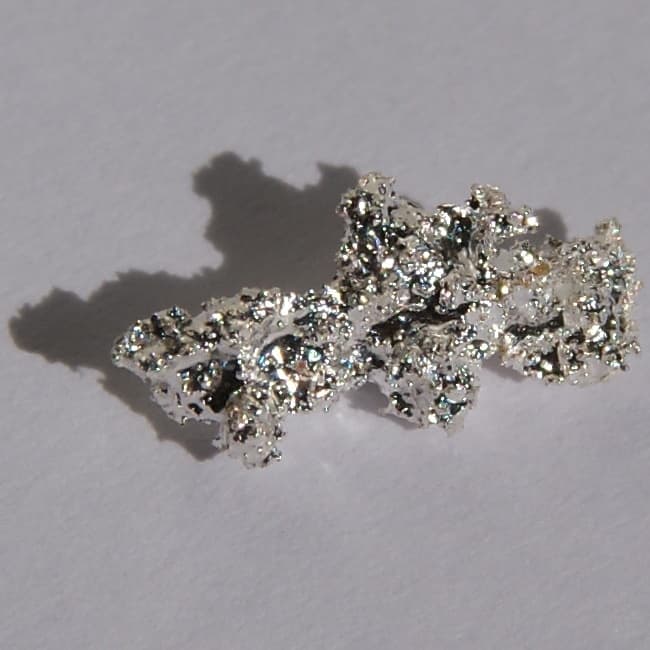
Silver commonly forms Ag+ in introductory ionic compounds.
Silver is Ag+ in essentially every compound: AgNO3 (the lab's silver workhorse), AgCl (the classic white precipitate), Ag2S (tarnish). Despite being a transition metal, it needs no Roman numeral — +1 is assumed.
Element
Silver
Symbol
Ag
Atomic number
47
Common ionic charge
+1
Common ions
Ag+
Visual reference
Silver element image and atomic model
Images are used as visual references; charge rules still depend on the compound.
Silver sample imageJurii, CC BY 3.0 <https://creativecommons.org/licenses/by/3.0>, via Wikimedia Commons, source: http://images-of-elements.com/silver.phpOriginal image sourceSilver Bohr modelAtomic model image from the open Periodic-Table-JSON dataset. It is a simplified electron-shell reference, not a scale drawing.Original Bohr model source
Where Silver's charge options come from
Silver is [Kr]4d10 5s1. Losing the single 5s electron leaves a perfectly filled 4d10 shell — such a tidy stopping point that higher states (Ag2+ exists in exotic fluorides) never trouble ordinary chemistry. Fixed charge, courtesy of a full d shell.
This is a classroom reference range, not an exhaustive list of all oxidation states.
The trap in Silver problems
Writing silver oxide as AgO. With Ag+ and O2-, two silvers balance one oxide: Ag2O. The same doubling applies to silver sulfide tarnish, Ag2S — one sulfur atom claims two silver ions.
Worked example: Ag in a formula problem
Why does the chloride test use silver nitrate, and what is the charge logic?
Ag+ meets Cl- and instantly forms insoluble AgCl, a white curdy precipitate — a one-to-one match of +1 and -1. Bromide gives cream AgBr, iodide yellow AgI: three halides distinguished by one silver ion.
Ag+ in real compounds
AgCl
Silver chloride
Ag+ balances chloride ions.
Ag2O
Silver oxide
Silver can form oxides where total positive and negative charge balances.
Questions students ask about silver
How does Ag+ kill bacteria in wound dressings?
The ion binds sulfur groups in microbial enzymes and membranes, shutting them down at concentrations harmless to skin. It is the ion that acts — metallic silver works only insofar as it slowly releases Ag+.
Why does silver tarnish black but not rust away?
Airborne sulfur compounds convert the surface to Ag2S (silver +1), a thin dark film that then protects the metal beneath. Unlike iron's flaking rust, tarnish seals; polishing or a baking-soda bath reverses it.
Was photographic film really built on silver's charge?
Entirely: light frees electrons that turn Ag+ into specks of neutral silver within AgBr crystals; the developer amplifies those specks a billionfold. Every black-and-white photograph is reduced silver ions.