Find gold's charge in the mining ion Au(CN)2-.
Two CN- give -2; overall charge is -1; so Au = +1. Heap-leach mining runs on this exact ion — dilute cyanide coaxing gold, atom by atom, into its rare +1 state.
Gold commonly forms Au+ Au3+ in introductory ionic compounds.
| Element | Gold |
|---|---|
| Symbol | Au |
| Atomic number | 79 |
| Common ionic charge | +1, +3 |
| Common ions | Au+, Au3+ |
Images are used as visual references; charge rules still depend on the compound.
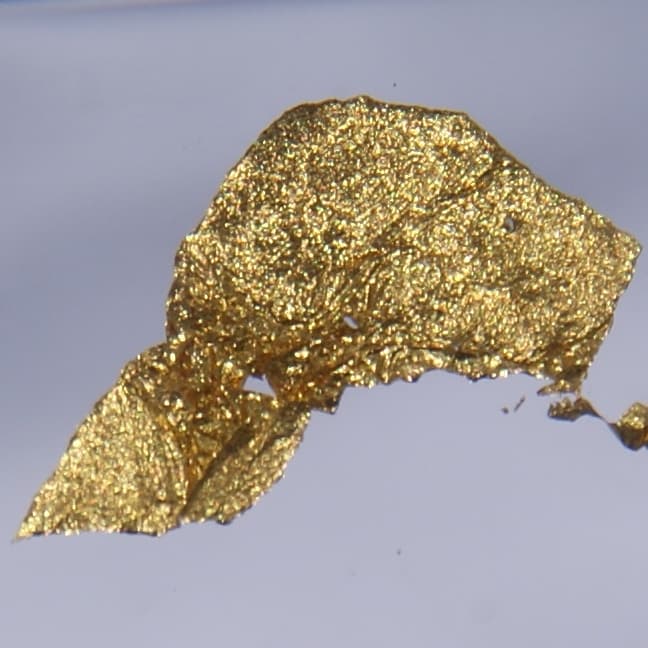
Gold is [Xe]4f14 5d10 6s1. Relativistic contraction grips its 6s electron ferociously — the same physics that colors gold yellow — making ionization brutally expensive. When forced, losing three electrons to d8 Au3+ (square-planar, like platinum's +2) beats the shallow d10 comfort of Au+, which survives mainly with soft partners like cyanide and sulfur.
This is a classroom reference range, not an exhaustive list of all oxidation states.
Writing 'gold doesn't react' as an absolute. Aqua regia dissolves it (nitric acid oxidizes a whisper of Au3+, hydrochloric traps it as AuCl4-), and cyanide solutions with air produce Au+ complexes — the basis of a century and a half of gold mining. Nobility has two well-mapped exceptions.
Two CN- give -2; overall charge is -1; so Au = +1. Heap-leach mining runs on this exact ion — dilute cyanide coaxing gold, atom by atom, into its rare +1 state.
Gold chloride
Au+ balances chloride ions.
Gold oxide
Gold can form oxides where total positive and negative charge balances.
Relativity again: gold's compressed orbitals absorb blue light where silver's don't. The same orbital contraction that guards its electrons paints the metal — charge chemistry and color share one cause.
Charge-0 gold spheres nanometers wide glow ruby red in suspension (medieval stained glass, pregnancy test lines) — conduction electrons sloshing in resonance, no ions required.
Rheumatoid arthritis was long treated with Au+ thiol drugs like auranofin — the soft +1 ion binding protein sulfurs. Metallic gold in teeth and jewelry stays 0 and inert.
Combine positive and negative ions so the total charge is zero — or let the ionic compound calculator do the crossing for you. The full chart lives on the periodic table with charges.
Charges and element facts on this page are checked against the primary references below. Found an error? Email hello@periodictablewithcharges.com — corrections ship in the next content update. See how this site is edited.