Assign antimony's oxidation state in Sb2O3 and in SbF5.
Sb2O3: three O at -2 give -6, so each Sb is +3. SbF5: five F at -1 give -5, so Sb is +5 — this one is among the strongest Lewis acids known, a key ingredient of 'magic acid.'
Antimony commonly forms Sb3- Sb3+ Sb5+ in introductory ionic compounds.
| Element | Antimony |
|---|---|
| Symbol | Sb |
| Atomic number | 51 |
| Common ionic charge | -3, +3, +5 |
| Common ions | Sb3-, Sb3+, Sb5+ |
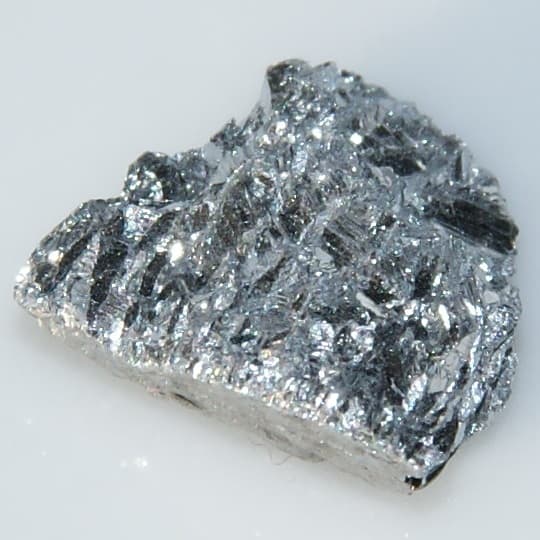
Images are used as visual references; charge rules still depend on the compound.
Antimony is [Kr]4d10 5s2 5p3, nitrogen's group four rows down. The three 5p electrons give +3 readily; recruiting the 5s pair for +5 gets harder as the inert-pair effect strengthens, so +3 outweighs +5 — the reverse of lighter phosphorus, where +5 dominates.
Reading antimony's symbol Sb as an error. It comes from the Latin 'stibium', the eyeliner compound Sb2S3 used since ancient Egypt — one of several elements (Fe, Ag, Sn, Pb...) whose symbols preserve Latin names.
Sb2O3: three O at -2 give -6, so each Sb is +3. SbF5: five F at -1 give -5, so Sb is +5 — this one is among the strongest Lewis acids known, a key ingredient of 'magic acid.'
sodium antimony compound
Sodium ions can balance Sb3- in simple ionic examples.
calcium antimony compound
Calcium ions can balance common negative Antimony ions.
Sb2O3 teams with brominated compounds: in a fire it forms antimony halides that scavenge the radicals feeding the flame. Alone it does little — the +3 antimony is the delivery system.
Trace Sb2O3 catalyzes PET production, and tiny antimony (+3) residues can migrate into water — well below safety limits, but it is why regulators monitor bottled water for antimony specifically.
Indium antimonide (formal Sb at -3) is an infrared detector material in thermal cameras — the narrow-gap semiconductor sees heat. Antimony's metalloid flexibility spans -3 to +5 across its applications.
Combine positive and negative ions so the total charge is zero — or let the ionic compound calculator do the crossing for you. The full chart lives on the periodic table with charges.
Charges and element facts on this page are checked against the primary references below. Found an error? Email hello@periodictablewithcharges.com — corrections ship in the next content update. See how this site is edited.