Write the formula for neodymium(III) oxide, the violet glass colorant.
Nd3+ with O2- crosses to Nd2O3. A pinch in glass gives the shifting lilac of 'alexandrite-effect' glassware that changes color between daylight and lamplight.
Neodymium commonly forms Nd3+ in introductory ionic compounds.
| Element | Neodymium |
|---|---|
| Symbol | Nd |
| Atomic number | 60 |
| Common ionic charge | +3 |
| Common ions | Nd3+ |
Images are used as visual references; charge rules still depend on the compound.
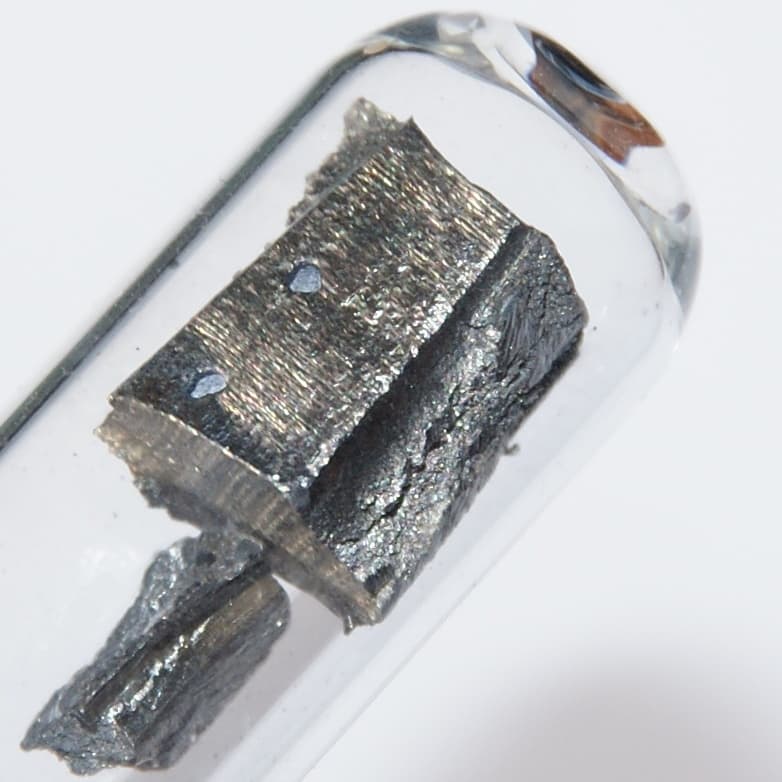
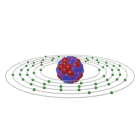
Neodymium is [Xe]4f4 6s2, and like nearly every lanthanide it settles at 3+ (f3) — the balance point where further ionization costs more than lattice or hydration energy repays. Its unpaired f electrons make both the ion and the alloy strongly magnetic.
This is a classroom reference range, not an exhaustive list of all oxidation states.
Thinking neodymium magnets attract because of ionic charge. Magnetism here is electron spin alignment in the neutral alloy; an N52 magnet carries no net charge. The Nd3+ ion appears in the mine and the chemistry lab, not in the magnet's pull.
Nd3+ with O2- crosses to Nd2O3. A pinch in glass gives the shifting lilac of 'alexandrite-effect' glassware that changes color between daylight and lamplight.
Neodymium chloride
Nd3+ balances chloride ions.
Neodymium oxide
Neodymium can form oxides where total positive and negative charge balances.
A few percent of yttrium sites carry Nd3+ instead; flashlamps pump its f electrons up, and their synchronized fall emits the infrared beam that cuts steel and removes tattoos. Identical 3+ charges make the substitution seamless.
Separating Nd3+ from other 3+ lanthanides in scrap requires the same tedious solvent-extraction chemistry as mining fresh ore — nearly identical charges and radii resist every shortcut.
NdI2 exists as a solid-state curiosity, but no aqueous or practical chemistry uses it. On any exam, neodymium is +3.
Combine positive and negative ions so the total charge is zero — or let the ionic compound calculator do the crossing for you. The full chart lives on the periodic table with charges.
Charges and element facts on this page are checked against the primary references below. Found an error? Email hello@periodictablewithcharges.com — corrections ship in the next content update. See how this site is edited.