Mercury commonly forms Hg+ Hg2+ in introductory ionic compounds.
Mercury has two faces: ordinary mercury(II), Hg2+ (HgCl2, HgS — the crimson pigment vermilion), and the peculiar mercury(I), which is never a lone Hg+ but always the dimer Hg2 2+ — two mercury atoms holding hands, sharing a +2 charge, as in calomel Hg2Cl2.
Element
Mercury
Symbol
Hg
Atomic number
80
Common ionic charge
+1, +2
Common ions
Hg+, Hg2+
Visual reference
Mercury element image and atomic model
Images are used as visual references; charge rules still depend on the compound.
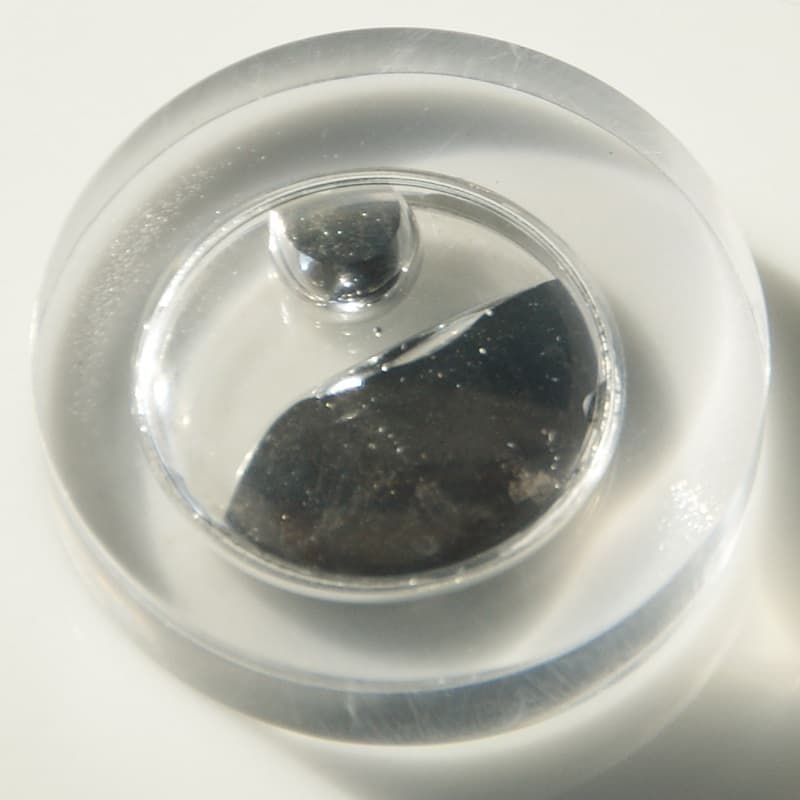
Mercury sample imageHi-Res Images of Chemical Elements, CC BY 3.0 <https://creativecommons.org/licenses/by/3.0>, via Wikimedia Commons, source: https://images-of-elements.com/mercury.phpOriginal image sourceMercury Bohr modelAtomic model image from the open Periodic-Table-JSON dataset. It is a simplified electron-shell reference, not a scale drawing.Original Bohr model source
Where Mercury's charge options come from
Mercury is [Xe]4f14 5d10 6s2, its 6s pair relativistically clenched — the grip so strong that mercury atoms barely bond each other, leaving the metal liquid. Losing both 6s electrons gives Hg2+; losing one per atom is only viable if two ions share a covalent Hg–Hg bond, hence the unique stable diatomic cation Hg2 2+.
This is a classroom reference range, not an exhaustive list of all oxidation states.
The trap in Mercury problems
Writing mercury(I) chloride as HgCl. The numeral I refers to +1 per mercury, but the real species is Hg2 2+, so calomel is Hg2Cl2 — the formula every general-chemistry exam loves to catch students on.
Worked example: Hg in a formula problem
Name Hg2Cl2 and HgCl2, and note the danger difference.
Hg2Cl2 is mercury(I) chloride (calomel), insoluble and once used in medicine; HgCl2 is mercury(II) chloride, soluble and violently toxic ('corrosive sublimate'). One charge state apart, historically the difference between remedy and poison.
Hg+ and Hg2+ in real compounds
HgCl
Mercury chloride
Hg+ balances chloride ions.
Hg2O
Mercury oxide
Mercury can form oxides where total positive and negative charge balances.
Questions students ask about mercury
What charge is the mercury in old thermometers?
Zero — liquid metal, atoms uncharged. The vapor those atoms shed is the neutral-atom hazard; the ionic hazards (Hg2+ and methylmercury) arise after environmental conversion.
What is methylmercury's charge story?
Microbes attach CH3- to Hg2+, making CH3Hg+ — a +1 organometallic ion fat-soluble enough to climb food chains into tuna. The charge is why it binds protein sulfurs; the methyl is why it reaches your nervous system.
How do I verify mercury(I) is really a dimer?
Classic evidence: calomel solutions are diamagnetic (a lone Hg+ would have an unpaired electron and be magnetic), and X-ray structures show the Hg–Hg bond outright. A tidy case of formulas following measurement.